Wildfire mitigation discounts: how to document the work
Carriers credit paperwork, not effort. A growing number of states now require insurers to account for wildfire mitigation when they rate a policy — and most homeowners who do the work never see a cent of it, because nobody told them an underwriter cannot credit what it cannot see.
Key takeaways
- Mitigation credit is applied when a policy is rated, usually 60–90 days before renewal. Work finished after a non-renewal letter arrives is next year's problem.
- Evidence beats effort. Dated before-and-after photographs from fixed vantage points, contractor invoices naming specific work, and product spec sheets.
- Third-party verification outranks everything you produce yourself. Many fire districts inspect defensible space free.
- Published discounts generally run from under 1% to roughly 20% per credited item, with more reported for third-party certified homes.
- Mitigation does not lower your hazard band. It changes your survival odds and how a carrier prices on top of the location.
The gap nobody mentions
Here is the sequence that plays out constantly. A homeowner gets a non-renewal notice. They spend a weekend and a few thousand dollars clearing brush, replacing vents and hauling the woodpile away from the house. They call their agent. The agent says that's great, and nothing changes.
The work was real. The risk reduction was real. But underwriting is a documentary process. The person deciding your rate is not standing in your garden — they are looking at a file, a catastrophe model output, and whatever evidence has been attached. Brush you cleared in April exists in the world but not in the file.
Where the rules actually exist
California has gone furthest. Its Safer from Wildfires regulation, adopted by the Department of Insurance in 2022 and codified at 10 CCR 2644.9, requires admitted insurers and the FAIR Plan to offer discounts or premium credits for specific mitigation actions where they write in wildfire-prone areas. The listed actions cluster around three levels: hardening the structure (Class A roofing, ember-resistant vents, enclosed eaves, multi-pane windows, non-combustible shutters), defensible space compliance including Zone 0 vegetation management, and community-level designations.
What it does not do is set a dollar figure. Each insurer files its own approach, which is why two carriers can credit the same work very differently, and why reading your carrier's actual filing matters more than reading the regulation.
Outside California the picture is thinner. Industry representatives have noted that California is the outlier in mandating discounts, with other western states instead working through wildland-urban interface building codes, mitigation grant funding and community-wide initiatives. Several states have separately moved on insurer disclosure — requiring carriers to reveal the wildfire score behind a rating — which gives you a different lever: the right to see the number you are arguing with.
Zone 0 deserves a note. California's Assembly Bill 3074, passed in 2020, directed the state to create an ember-resistant zone standard for the first five feet. The regulatory process has run for years and the enforceable statewide rule has been slow to finalise, so CAL FIRE guidance has described Zone 0 as best practice in the interim. Do not wait for an enforcement date — underwriters and fire districts are already asking about it, because ember ignition is the leading cause of home loss.
State rules change. Confirm the current position with your state's Department of Insurance consumer line, which can also tell you your actual notice period and appeal rights — information an agent's script often does not cover.
What underwriters accept: the evidence hierarchy
Evidence falls into a rough hierarchy. The further down this list you can get, the more weight it carries.
| Evidence | Weight |
|---|---|
| Telling your agent what you did | None. It does not enter the file. |
| Undated photographs | Minimal. No way to establish when or where. |
| Dated before-and-after photographs from fixed vantage points | Useful. The baseline is what makes the "after" meaningful. |
| Contractor invoices naming the specific work | Strong. A third party attesting to scope and date. |
| Product spec sheets for rated components | Strong. A vent's listing number or a roof's Class A rating is a fact, not a claim. |
| Defensible space inspection from your fire district or state agency | Very strong. Frequently free on request. |
| State wildfire mitigation verification form, completed | Very strong. Purpose-built for exactly this submission. |
| Third-party certification (e.g. IBHS Wildfire Prepared Home) | Strongest individual evidence. Some carriers credit it heavily. |
| Community designation (Firewise USA, Fire Risk Reduction Community) | Applies to the whole neighbourhood, and stacks with individual credits at several carriers. |
How to photograph it properly
This is the part people get wrong, and it costs nothing to get right.
- Shoot the "before" first. A photograph of clean gravel against a wall proves nothing on its own. The same view with bark mulch and a juniper in it, dated two weeks earlier, proves everything.
- Use fixed vantage points. Pick four or five positions — each elevation of the house, the driveway approach — and shoot from the same spots every time. Consistency is what makes a sequence readable to someone who has never been there.
- Include something for scale when the point is distance. A tape measure laid out from the wall through the first five feet makes a Zone 0 claim self-evident.
- Leave the metadata alone. Phone photos carry date and GPS in EXIF. Do not screenshot them, do not run them through an editor that strips it, and do not send them through a messaging app that recompresses them. Email the originals to yourself and keep that thread.
- Photograph details, not just wide shots. The mesh on a vent. The stamp on a roofing bundle. The gap under the deck after you closed it in. Close-ups are what an underwriter can actually assess.
What to document, in priority order
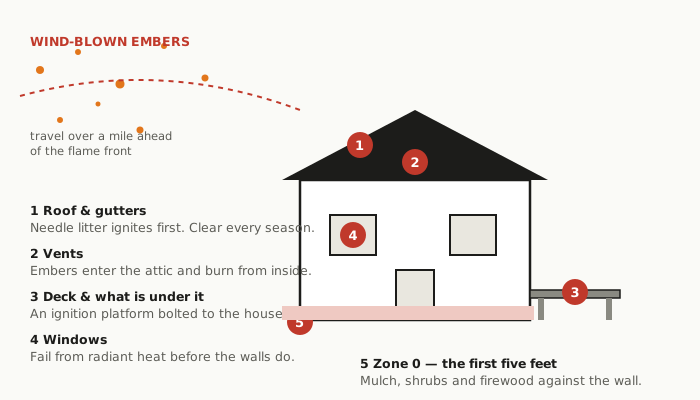
These map to what actually determines whether a house survives, which is roughly the order carriers care about. The full mitigation guide covers the how.
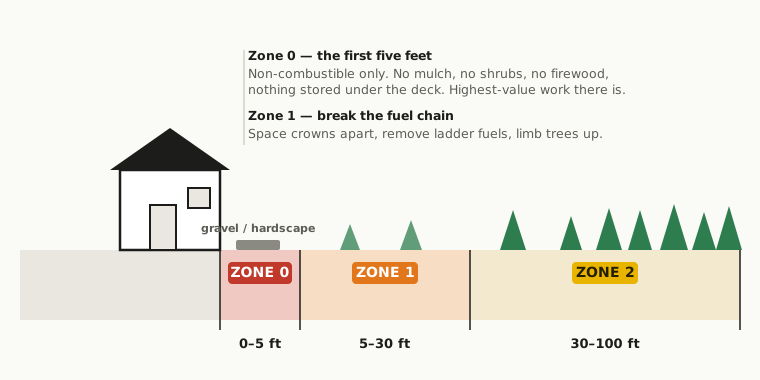
1. Zone 0 — the first five feet
Non-combustible ground cover against every elevation. Photograph each side separately. Show what came out: the mulch, the shrubs, the firewood, the plastic planters, the things stored under the deck. Highest-value work available, and the cheapest.
2. Vents
Embers enter attics and crawlspaces through vents and ignite the house from inside. Photograph every vent close up after screening or replacement. If you fitted listed ember-resistant vents, photograph the product label and keep the documentation — the listing number is worth more than any photograph of the installed vent.
3. Roof, gutters and eaves
For a Class A rated roof you need the paperwork that says so: invoice, product data sheet, or permit. Enclosed eaves appear on most state mitigation lists and are easy to evidence with a single clear photograph. Roof valley and gutter clearing is maintenance that must be repeated — re-photograph annually rather than relying on a picture from three years ago.
4. Deck, siding and the six-inch base
An attached wooden deck is an ignition platform bolted to the house, and what is stored underneath is usually worse than the deck. Photograph it cleared, and the enclosure if you built one. The non-combustible base of the wall should be photographed at ground level, not from standing height.
5. Windows
Multi-pane and tempered glass appear on mitigation lists because windows fail from radiant heat before the structure does. Spec sheets or the installer's invoice.
6. Zones 1 and 2
Wider shots showing crown spacing, removed ladder fuels and limbed trees. Contractor invoices matter more than photographs here, because scale is hard to convey in an image and a bill reading "limb and thin 1.2 acres" is unambiguous.
Named programs and forms that carry weight
Generic effort is hard to credit. Named programs are easy to credit, because the carrier already knows what they mean.
- State verification forms. The California Department of Insurance publishes a wildfire mitigation verification form designed for formally recording completed work for submission to an insurer. Completing it is not a guarantee of a discount, but it puts your evidence in the shape the system expects.
- Free fire district inspections. Many counties and fire protection districts will inspect defensible space on request at no charge and give you the result in writing. This is the single best return on an hour of your time.
- IBHS Wildfire Prepared Home. A third-party certification from the Insurance Institute for Business & Home Safety. Because it is an insurance industry body, carriers recognise it readily, and it is associated with the largest reported reductions.
- Firewise USA. An NFPA community recognition programme. Status in good standing is credited by several carriers and applies to the whole neighbourhood, which makes it worth more than anything you can do to one parcel alone.
- Fire Risk Reduction Community. A California Board of Forestry designation that carriers verify by address.
What it is actually worth
Nobody publishes a formula that converts cleared brush into a renewed policy, and anyone offering one is guessing. The realistic picture from published figures: roughly under 1% to 20% off per credited item, with substantially larger reductions reported at some carriers for homes certified under a recognised third-party programme.
The more important number is the one nobody quotes. For a homeowner who has already been non-renewed, documented mitigation is frequently the difference between getting a quote at all and being declined again. That is not a discount — it is access.
Timing: the part that decides everything
Mitigation credit is applied when a policy is rated. That is a specific moment, and it usually happens well before your renewal date — commonly 60 to 90 days ahead.
Which means work finished two weeks after a non-renewal letter lands has done nothing for your pricing for another full year. The risk reduction is immediate. The financial recognition is not.
How to submit the package
Make it easy to say yes to. An underwriter with twenty files to clear will not assemble your argument for you.
- One PDF. Not forty loose attachments. Cover page with property address and policy number, then a section per item.
- A one-page summary at the front. What was done, when, by whom, with the evidence for each line referenced by page number.
- Invoices attached to the work they describe, not dumped at the end.
- Ask a narrow question in writing. Not "do you offer discounts for mitigation" but "which of these specific items qualifies for a mitigation adjustment under your filing in this state, and what verification do you require?" Vague questions produce vague answers.
- Get written confirmation of receipt. If it is not on the file, it did not happen.
- Check the renewal declaration when it arrives to confirm the credit was actually applied.
If you are already non-renewed
Document anyway, and quickly. Read the letter for the specific reason cited rather than the general one — carriers are often required to give a basis more specific than "wildfire risk", and that basis tells you what to fix first. If it mentions vegetation, defensible space is the priority. If it mentions roof or vents, structural hardening comes first.
Then call your state's Department of Insurance consumer line before your agent, to confirm your actual notice period and appeal rights. After that you are shopping the surplus lines market, and a broker presenting a clean evidence package gets a different reception than one presenting an address and a hazard score. It does not guarantee a placement. It changes the conversation.
The full non-renewal sequence covers what else to do inside that window, and how FAIR Plan and difference-in-conditions cover fit together if it comes to that.
Questions people actually ask
Does mitigation lower my wildfire risk score?
No, and be suspicious of anyone who says otherwise. A hazard score measures the location: the terrain, the fuel on the ridge above you, the recorded fire history nearby. Clearing your garden moves none of that. Check your score and it will read the same the week after you finish. What mitigation changes is your actual survival odds, and how an underwriter prices the risk on top of the location. Both are worth having. Neither is the band going down.
Will documentation stop a non-renewal?
Not reliably. Carriers manage concentration of exposure as well as individual risk, so a fully compliant home in a region a carrier is exiting can still be non-renewed. Documentation matters most at the next step — when you are shopping a replacement.
Do I need a professional inspection?
Not always, but third-party verification carries far more weight than anything you produce yourself. Start with your fire district, since many inspect free. Certified wildfire mitigation specialists exist where you need something more formal.
How often do I need to redo this?
Vegetation and gutter work is maintenance, not a one-off, and underwriters know it. Re-photograph annually from the same vantage points. Structural items — roof, vents, windows — only need documenting once, but keep the paperwork permanently.
Does any of this help with a claim?
Indirectly. A dated record of the property's condition before a loss is useful evidence in a dispute about contributing factors, and it is one more reason to keep the package somewhere you can retrieve it if the house is gone. Store a copy off-site or in the cloud.
What if my carrier says it has no mitigation credit?
That is a real answer and a useful one. It tells you the effort of assembling a package will not be recognised there, and that you should be shopping a carrier whose filing does recognise it. Ask an independent broker specifically which carriers in your state credit mitigation.
General information, not advice about your policy or property. Wildfirely is not an insurer, broker or licensed agent. Mitigation credit rules, defensible space standards and notice periods vary by state and change — confirm specifics with a licensed agent in your state, your local fire authority, and your state Department of Insurance. Terms used here are defined in the glossary.